08 November 2013

No Rest for the Infirm

Most folks who've ever been in a hospital know that it's no place to rest up. Hospitals in Prague are no different. During the day there are long periods of time for naps, but the beginning and end of each day are packed with tests, shots, and poking and prodding. Here's a typical start to my day while I was at Fakultni Nemocnice Motol:

5:30- 6amTemp, blood pressure, 4 vials of blood, small amount for glucose monitor, EKG. 
Then, around 7amBreakfast, usually consisting of a large amount of white bread (a "no-no" for this diabetic), some butter, maybe some jam, and something called "white coffee" which is not coffee. 
Between 8 and 10 amVelke Vizita (Grand Rounds). The head doctor goes around the ward with younger doctors and students, talking about each patient.  Often, they take the opportunity for poking and prodding exactly where you hurt.
Meals are at 7, 12, and 5. Fruit tea (a ghastly beverage) is available at all times). 
Lights out at 11pm - after evening shots, temp, blood pressure, adjustments to IV bags, etc.

Obviously, one needs to go home to get any rest, unless the Red Sox are playing in game six of the World Series on another continent and the game begins at 1am.

05 November 2013

Off Chicanery (temporarily)

My younger daughter has always had a way with words (her sister's no slouch either). She's also a librarian, so she reads books with big words, sometimes. Just after I had my emergency surgery (Oct. 3), she called me from Connecticut. Part of the conversation went like this.

Librarian: So, he disemboweled you. 
Me: I guess you could put that way. 
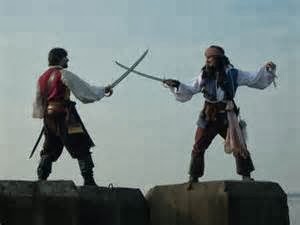
Librarian: You know, I've heard that when pirates got disemboweled they took at least a year off from all chicanery.
 So, I guess I have to swear off all chicanery. 

BTW, a reminder that a full explanation of the health trials and hospital stay can be found at http://viewsfromtheloft.blogspot.com.

01 November 2013

Na zdravi

So I was in the surgical post-op ward in the Fakultni Nemocnice Motol (Teaching Hospital at Motol) in Prague. This is one of the five rooms I was in during my three plus weeks in the hospital.

My roommate on my right had a visitor come in. I could tell something was up by the look on the visitor's face. Sure enough, I heard clunk, clunk. I looked over and there were two bottles of Pilsner Urquell on the table next to my roomie's bed. BUT, the visitor had forgotten the opener.

No problem. He went out and asked the staff for one! Doctors and nurses were in and out of the room. No issue. The buddies spent and hour and a half drinking a beer and talking.

Na zdravi (to your health; cheers). Welcome to the Czech Republic.


29 October 2013

Update on Life

I've been out of circulation for nearly a month. Time to share an update. Bear with me as I unfold a brief chronology. In the weeks to come I will again be out of commission, but until that time I will post a few vignettes of hospital life in Prague.

I had been having diarrhea and went to the hospital, returning four days in a row for tests. On the fourth day, October 2, I was admitted to the infectious disease ward. Then I started bleeding, heavily. It got bad.

On October 3, I was rushed to surgery. The doc said have this surgery or die. He performed a sub-total colectomy. He took out my large bowel altogether. My librarian daughter said, "oh, he disemboweled you!" 

So then, I was put in surgical ICU to begin recovery. The docs kept saying "this is no small surgery."

On October 14, I was well enough to go home and was waiting for my wife to come get me. I took a nap. When I awoke I was in the throes of a heart attack! No history of such things. So they rushed me to cardiology and put a stent in one of the arteries. The doctor (a Czech, of course) actually said to me, "I have some good news and some bad news." He said my heart was functioning well with the stent, but that all my arteries are in bad shape and I will need bypass surgery in 4 to 6 weeks.

I ended up in the hospital for more than three weeks, just arriving home a few days ago. Now we will travel to the US for the surgery. I'm not worried about having it done here, but family is in the US. 

  • Please pray for my body.
  • Please pray for my wife. She's taken on a lot of new burdens, including care and worry.
  • Please pray for our travel. I've been cleared to travel on November 4.
  • Please pray about finances. Insurance will cover only a small portion of the medical costs in each country.

God has been evident in my trials. His sovereignty is unquestioned.

Joshua 1:9. "Have I not commanded you: be strong and courageous. Do not be frightened, and do not be dismayed. The Lord your God is with you wherever you go."

20 September 2013

Are you ready to rumble?

Not too long ago, Sandra and I hosted a family from the St. Louis area. Dad is a Lutheran (LCMS) pastor, so pastoral topics were among the many topics discussed during their visit. One of the discussions, which took place over several sessions, was on the lack of preparedness of seminarians for the difficult aspects of the pastorate.

In our different seminary backgrounds, we both noted that theology, history, ancient languages, ecclesiology, and preaching were well-covered in the curriculum, but that actual life in the church - the harder aspects - were not.

So it was with interest that I came across this piece in the Aquila Report recently. It is written to help prepare would-be pastors for the rough and tumble world of the pastorate, but it's a good essay for all church members to read and reflect upon.

Jared Moore writes,
The blessings of ministry far outweigh the realities below; however, ministry is definitely not easy. Don’t waste your time and money going to seminary or college for pastoral training if you are not prepared for the negative aspects of ministry mentioned below. Furthermore, always remember that God has called you to love His church, not merely His mature church, but His immature church as well. Moreover, a call to ministry is a call to bleed.
To read the rest of this article go here


17 September 2013

Who is God, #3

How ought we respond to the statements that God is God, and that He must be our only God? Allow me to make a suggestion.

God Must Be Our Focus of Worship.  The Westminster Shorter Catechism, in its very first question, asks, “What is man’s chief end.” The answer is, “Man’s chief end is to glorify God and to enjoy Him forever.”  

We must glorify AND enjoy God. These are not two separate commands. To Glorify God is to enjoy Him. This is worship. The more we learn of God, the more we can appreciate Him – and how great His love is for us. Romans 5:8 states that "...God shows his love for us in that while we were still sinners, Christ died for us."  Can we read that; understand it; and not glorify Him; not revel in His love? Not enjoy the blessing of being one of His?

We must do glorify and enjoy Him realistically. Understand this,  we do live in a sin-filled world. It’s a hard world to enjoy sometimes. God knows that. Do you think Jesus was smiling as the thorns bit into his skull; as the breath was crushed from His body?  Enjoying God does not mean that we have to slap a fake smile on and pretend that all is right on earth. But we do need to remember that God is in His heaven, and He has both the power and the will to love us beyond our own imagining.


In 1 John 3:1, we read the following, "See what kind of love the Father has given to us, that we should be called children of God; and so we are." And so we are. Worship the one true God, and Him alone. And enjoy it.

10 September 2013

You can't go back!


It’s the time of year when families, schools, fraternal organizations and other affinity groups plan reunions. I’m not much of a reunion — or nostalgia — fan. I’ve only ever been to two reunion events. The first took place more than ten years ago. It was not a school reunion, however. It was a gathering of former crewmembers of the USS Georgetown, the ship on which I served almost 50 years ago, when I was on active duty with the U.S. Navy.

We old fogies had a good time. We wore nametags, because some of us had changed just slightly. We watched some grainy super 8 movies, mostly having to do with our antics when we crossed the equator. We sat there in amazement, wondering who those slim young men on the screen were — and where they’ve gone. We all spent time visiting with one another and walking around Key West, a port of call with which we were all familiar — decades ago.

Key West has changed, just as I and my shipmates have changed. We all got older, raised families, and did other things that are pretty normal. Most of our families are grown now, and some of the wives aren’t the same ones with whom some of the guys started out married life. Key West went from a sleepy town with a Navy base to one of the premier tourist destinations in the country.

You can’t go back.

Most of us realized we were not going to relive the days of our youth by visiting Key West. Our bodies wouldn’t have handled it if we had tried. I have come face to face with this realization numerous times in the past few years.
A few years back I took my youngest daughter to visit the city in which I had grown up and the high school from which I had graduated (fast forward a few more years and I attended another reunion – the 50th anniversary of my graduation from that same school!). The reality was somewhat shocking. None of the houses in which I had lived were still standing. The school had bars on the windows and doors — and probably hadn’t been swept since I graduated. My daughter grew to have a better understanding of the socio-economic background from which I have emerged. I learned a few things, too.

You can’t go back.

It’s good to have memories — and it’s important to actually think about creating memories as we go along in life. It’s good to remember both the good and the bad in our own biographies. The good we can improve upon. The bad, perhaps, we can learn from. But we can’t change any of it.

The most important change in my life since “the old days” was one over which I had no control. For His own reasons, God chose me to be one of His own. In 1978, a dozen years after I separated from the navy, I was enlisted in God’s army. Now I am on a career path which leads to eternal life.

I don’t want to go back.

Fortunately, we can alter our present and our future. I was reminded, more than once, while in Key West, that I could easily have been voted “least likely to succeed,” if they voted on such things aboard the Georgetown. I drank hard and fought often and generally kept myself in trouble. Shipmates told me they are surprised at “how well I’ve turned out.”

Me too!

When I left the Navy, I went to college; not because of a thirst for knowledge, but because the G.I. Bill gave me money to do so. My attitude and my behavior didn’t change much. But things are very different now. God has ordered my steps. He has allowed me to have the kinds of background and experiences and education which some people find helpful. His hand has been obvious in my life. Just when I thought I was going to sneak off to Maine and become a semi-retired type, a congregation recruited me to be its pastor. I have been called upon to use skills and education for which God had prepared me, but which I have scarcely used in the past few years. And I have plenty to share with these people to whom He sent me.
Now I have “retired” from that congregation in Maine and live and minister in Prague, Czech Republic.

You can’t go back. I really wouldn’t want to, but it is fun reminiscing about “the good old days.” We just can’t live there. We have to move on.

We of the USS Georgetown talked about the next reunion. It never happened. I guess once was enough. I enjoyed that reunion, but I’m glad to be back in the present. There’s never a dull moment in the adventure.

By the way, I also can’t go back and visit the USS Georgetown. It was decommissioned in 1969. My understanding is that it was sold as scrap metal to the Gillette company. Maybe I shaved with part of it this morning!

I certainly can’t go back.